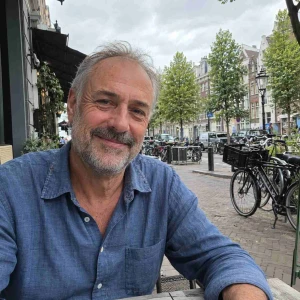
Feed the same face through an image model for an afternoon and a pattern shows up fast. The snapshots all share the same tells: flat front lighting, a plain untilted frame, skin with no texture, and color that looks printed rather than filmed. A movie still behaves differently. It carries light that comes from somewhere, a lens with a point of view, and a grade that sets the mood before anyone reads the scene.
The prompts below were built the slow way, changing one variable at a time to see what actually moves an image from AI headshot to frame from a film. Copy them, swap the subject, and keep the structure intact.
THE SHORT VERSION
Name five things in this order and almost any current model returns something filmic: subject, lighting direction, lens and film stock, color grade, and a wide aspect ratio. One strong light idea beats a pile of adjectives, and 2.39:1 framing does more work than the word "cinematic" ever will.
Why most AI portraits read as snapshots
Five habits give an image away. Each one has a direct fix in the sections that follow.
Flat front light
Even light from the camera position kills depth. Film light arrives from an angle and leaves shadow.
A plain frame
Square or vanilla 3:2 reads as a photo. Film lives in wide and boxed formats.
Plastic skin
No pores, no grain, no imperfection. Real footage always has texture.
Printed color
Clean, default color looks digital. A film frame carries a deliberate grade.
Dead eyes, dead center
A centered subject staring down the lens flattens the shot. Film composes off-center with a catchlight.
The anatomy of a movie-still prompt
A reliable prompt is six layers stacked in a fixed order. Token position still maps to influence in current models, so the subject leads and the technical direction closes it out.
| Layer | What to name in the prompt |
| Subject and wardrobe | Who they are, age, clothing, expression, and what they are doing |
| Setting and atmosphere | Location, time of day, weather, plus haze, dust, rain, or smoke |
| Lighting | Direction, hardness, and one key idea such as rim light or single source |
| Lens and camera | Focal length, depth of field, and a camera or film stock |
| Color grade | The palette and contrast, such as teal and orange or bleach bypass |
| Framing and finish | Aspect ratio, grain, composition, and any tool parameters |
Assembled, the skeleton looks like this:
Cinematic film still, [subject + wardrobe + expression], [setting + atmosphere], [lighting], [lens + film stock], [color grade], [aspect ratio + grain]
The vocabulary that does the work
Cinematographers think in a small, specific vocabulary. Borrow it. These four tables are the reference the prompts draw from.
Aspect ratio: the fastest cinematic signal
| Ratio | Feel and when to use it |
| 2.39:1 (21:9) | Anamorphic widescreen. Maximum film feel. Epics, thrillers, wide environmental portraits |
| 1.85:1 | The standard theatrical frame. Classic and less extreme. Drama and character work |
| 4:3 (Academy) | Vintage and boxed-in. Period pieces and intimate tension |
| 4:5 or 2:3 | Vertical frames that still need to feel filmed. Posters and social portraits |
| 16:9 | Modern television-drama look. Familiar, a little less cinematic than 2.39:1 |
Lighting: where the drama lives
| Term | What it gives you |
| Low-key, chiaroscuro | Deep shadows, high contrast, one dominant light. Drama and threat |
| Rim light, backlight | A bright edge separating subject from background. Depth and glamour |
| Golden hour | Warm, low, soft sun. Nostalgia and romance |
| Single hard source | One directional light with sharp shadows. Tension and sculpted features |
| Soft key | A large diffused light with gentle falloff. Beauty and editorial |
| Motivated, practical light | Light that visibly comes from a lamp, window, or neon in frame. Realism |
Lens, camera, and film stock
| Term | The look it pushes |
| 85mm, shallow depth of field | Flattering compression and a creamy background. The portrait default |
| 35mm or 40mm | Wider, with more environment in frame. Reportage and unease |
| Anamorphic flare, oval bokeh | Horizontal streaks of light and oval highlights. The blockbuster signature |
| Kodak Portra 400 | Warm, natural skin with gentle contrast. Everyday film beauty |
| Cinestill 800T | Tungsten night film with red halation glowing around lights. Neon and rain |
| Ilford HP5, pushed | Gritty, high-contrast black and white grain. Raw documentary |
| Kodak Vision3, Fuji Eterna | Muted, true motion-picture color. Prestige and period |
Color grade: mood before meaning
| Grade | Mood and genre |
| Teal and orange | Warm skin against cool shadows. Blockbusters and action |
| Desaturated, high contrast | Color pulled out and shadows crushed. Thrillers and crime |
| Bleach bypass | Retained silver, steely and harsh. War and gritty realism |
| Golden amber, low contrast | Soft warm nostalgia. Romance and memory |
| Cold cyan, one warm accent | Clinical with a single glow. Sci-fi and horror |
| Muted earth tones | Browns, greens, and soft light. Period and literary drama |
Copy-paste prompts you can steal
Eight looks, each built on one clear lighting idea. Swap the subject and wardrobe, keep the technical tail. For Midjourney, add parameters such as --ar 21:9 at the end instead of the written ratio.
1. Golden-hour close-up
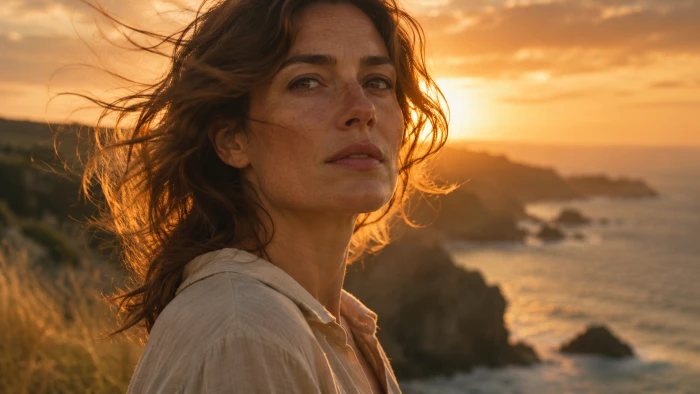
Cinematic film still, close-up portrait of a woman in her early thirties, loose linen shirt, wind catching her hair, standing on a coastal cliff at golden hour, warm low sun behind her creating a soft rim light, shallow depth of field, 85mm lens, shot on Kodak Portra 400, warm amber grade with soft shadows, fine film grain, 2:3 framing
Why it works: a low backlight plus the Portra palette reads as a real frame, not a studio headshot.
2. Neon noir at night
Cinematic film still, medium portrait of a man in a dark overcoat on a rain-soaked city street at night, neon signage reflected in puddles, wet skin catching magenta and cyan light, anamorphic lens flare, shot on Cinestill 800T with visible red halation around the lights, teal and orange grade, shallow depth of field, 35mm, atmospheric haze, 21:9 widescreen
Why it works: Cinestill halation and anamorphic flare are the exact signals of night cinematography.
3. Low-key chiaroscuro
Cinematic film still, tight portrait of an older man with a weathered face, single hard light from the side leaving half the face in deep shadow, black background, high-contrast chiaroscuro, a single catchlight in one eye, visible skin texture and pores, 100mm lens, desaturated color with warm skin, fine grain, 4:5 framing
Why it works: one motivated source against a black field is how portrait drama is lit on set.
4. Bleach-bypass thriller
Cinematic film still, three-quarter portrait of a field operative in worn gear, overcast grey daylight, bleach bypass look with retained silver, desaturated steel-blue palette, high contrast, hard directional light, heavy grain, handheld documentary feel, 40mm lens, 1.85:1 theatrical framing
Why it works: bleach bypass crushes color and lifts contrast, the signature of gritty crime and war films.
5. Period drama, candlelit
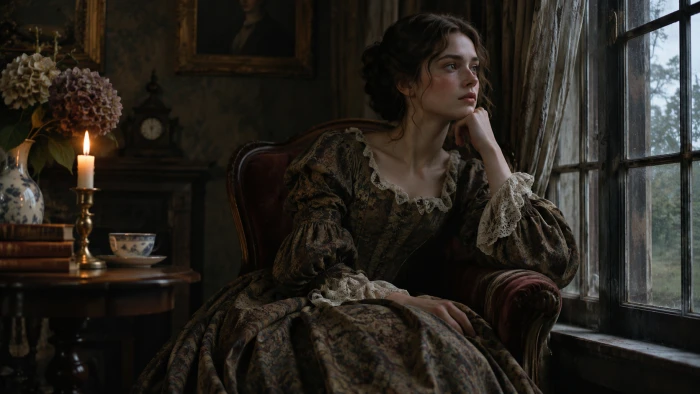
Cinematic film still, seated portrait of a young woman in 1870s dress by a window in a dim parlour, soft candlelight and cool window light mixing on her face, painterly low-key lighting, muted earth tones, shallow focus, 50mm lens, Kodak Vision3 500T emulation, gentle grain, 1.85:1 framing
Why it works: mixed warm and cool practical light plus muted earth tones evoke prestige period photography.
6. Cold sci-fi interior
Cinematic film still, medium shot of an astronaut removing a helmet inside a cramped spacecraft, cold cyan panel light on the face, a faint warm readout glow as the only accent, clinical fill with deep shadows, shallow depth of field, anamorphic 2.39:1, muted blue-green grade, fine grain
Why it works: a cold dominant hue with one warm accent is the standard palette split of modern sci-fi.
7. High-key editorial
Cinematic film still, upper-body portrait of a model against a soft seamless backdrop, large soft key light, bright even high-key exposure, creamy highlights, shallow depth of field, 85mm f/1.4, medium-format rendering, pastel grade, barely-there grain, 4:5 framing
Why it works: high-key soft light with medium-format rendering reads as polished magazine cover work.
8. Western wide shot
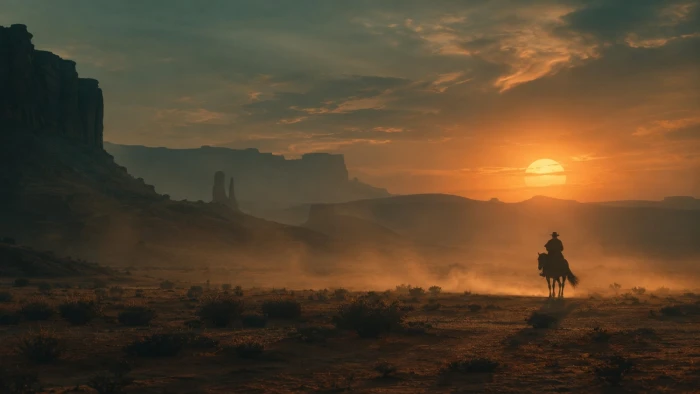
Cinematic film still, wide environmental portrait of a lone rider silhouetted against a vast desert at dusk, long shadows, dust in the air catching the backlight, warm amber and dusty teal grade, anamorphic lens flare, shot on 65mm, deep focus, heavy atmosphere, 2.39:1 widescreen
Why it works: a small figure in a huge frame with backlit dust is pure widescreen Western grammar.
Tuning for each tool
Version numbers in this space change every few months, so the vocabulary above matters more than the badge on the tool. Current strengths break down like this.
| Tool | Best for, and how to steer it |
| Midjourney (V8 line) | Atmosphere, composition, and editorial taste. Put style words last, then use --ar for the frame, --stylize for how much it art-directs, --raw for a literal photographic look, and --sref to lock a style across shots |
| Google Nano Banana Pro | Photoreal faces and keeping the same person across several shots, plus fast edits. Write plain descriptive sentences and refine by asking for one change at a time |
| FLUX.2 | Literal prompt-following and clean skin. Reach for it when the frame has to match the words exactly |
| ChatGPT, GPT Image | A dependable all-rounder with precise conversational edits and accurate text when a sign or title sits in frame |
| Adobe Firefly | Commercially safer training data and an Adobe workflow. Useful for client-facing work |
When it still looks wrong: quick fixes
Most misses trace back to one missing layer. Match the symptom to the fix and regenerate.
| Problem | Fix to add |
| Skin looks plastic | Visible skin texture, pores, fine film grain, and a named film stock |
| Image feels flat | A light direction (rim light, single hard source) plus low-key or high contrast |
| Pose looks stiff | Candid, caught mid-motion, looking away from camera, off-center composition |
| Color looks digital | A grade such as teal and orange, bleach bypass, or muted earth tones |
| Not reading as cinema | Widen to 2.39:1 and add anamorphic lens flare and letterbox bars |
| Eyes look lifeless | Catchlight in the eyes and sharp focus on the eyes |
One rule on real faces
Reference the look, not the person
Recreating the lighting, lens, grade, and era of a film is fair game and is exactly what these prompts do. Generating the face of a real actor or a real private individual without consent is a different matter, and many platforms and jurisdictions restrict it. Describe an era and an aesthetic rather than a named person, and disclose AI images where a client, platform, or law expects it.
The verdict after a lot of generations
What holds up across hundreds of renders is simple: the technical layer carries most of the result. Name the light, the lens, the stock, and the grade, and almost any current model hands back something that passes for a film frame. The looks that land hardest are the ones built on a single strong lighting idea rather than a stack of descriptors.
Where it turns frustrating is control. Faces still drift between generations, so a consistent character across several shots needs reference images or a tool built for that job. Hands and in-frame text stay unreliable. Models read film-stock names loosely, which makes the grade a starting point to correct later rather than a guarantee. And the wider the frame, the more a model wants to fill it with scenery instead of keeping the subject the hero.
What works well
- One strong light direction does most of the heavy lifting
- Film-stock and grade names shift mood instantly
- Wide aspect ratios read as cinema on their own
- Close-up skin and fabric render convincingly
What to plan around
- Faces drift between generations without references
- Hands and in-frame text are still hit or miss
- Stock and grade names are loose, so color needs hand-correction
- Wide frames tempt the model to bury the subject
The practical read: treat the prompt as a lighting and lens brief, generate in batches, and finish the color by hand. Do that, and film-grade portraits stop being luck.

Join the discussion